Game Music Licensing: What You Need Before You Ship
To use music in a commercial game, you need written permission that covers the game’s platforms, territory and term. For a well-known song that means two licenses, negotiated one by one. For original or generated music made for your project, the license is simple, and for an RPG Maker project that is the fastest, cheapest route. We build browser-based music generators for RPG Maker MZ and MV developers, so this guide covers both paths: licensing existing songs, and picking game music that comes with commercial-use terms.
TL;DR
- Using a known song takes two licenses: a sync license for the composition and a master use license for the recording. Neither has a compulsory route in the U.S.
- A purchased album, a streaming subscription or a short clip does not give you game rights. There is no ten-second rule.
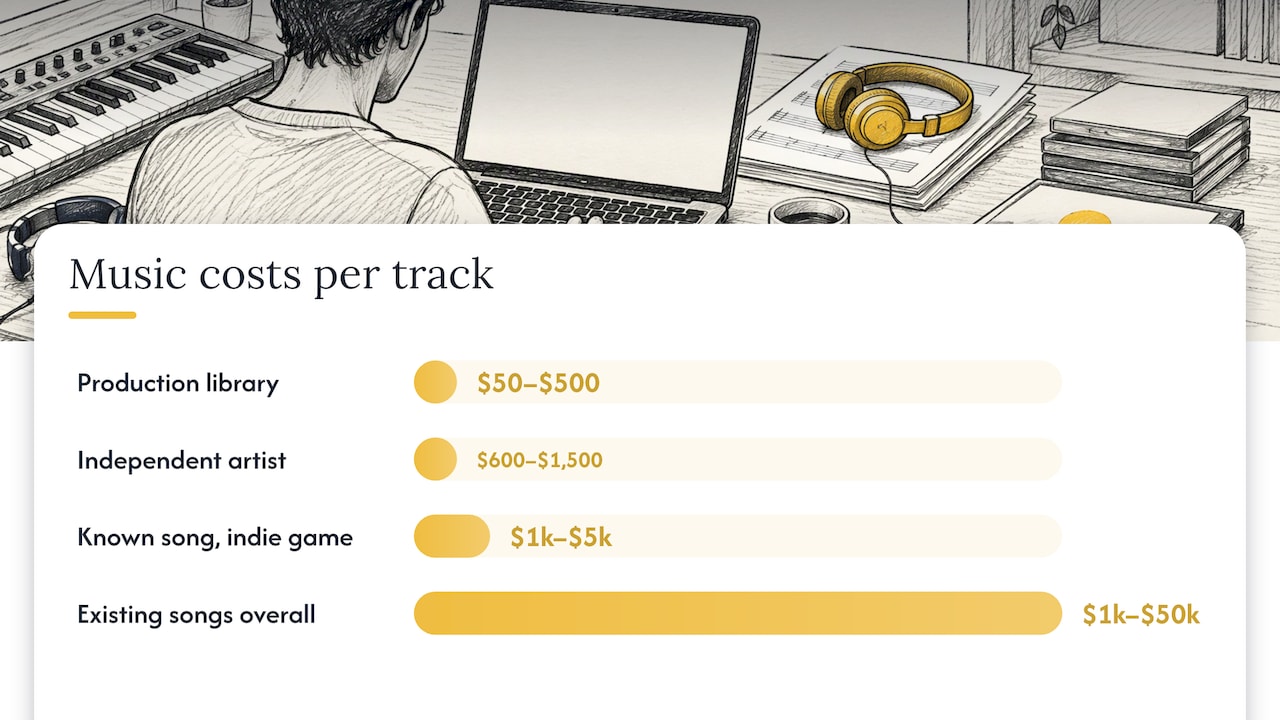
- Per-track prices range from roughly $50 for library music to $5,000 or more for known songs, and the price depends on the package you negotiate.
- Read every asset license for four things: commercial use, modification, redistribution and attribution.
- For RPG Maker projects, music generated for your game under clear commercial-use terms avoids most of this negotiation.
Table of Contents
- The two rights behind every licensed song
- How to license an existing song, step by step
- What game music licensing costs
- What “royalty-free” means for a game
- Checking any game asset license
- RPG Maker: music and asset rights in practice
- Why generated music fits small teams
- Perspective
- Your next step
- FAQ
- Sources
The two rights behind every licensed song
A song in a game is really two copyrighted things. The composition (melody, harmony, lyrics) belongs to the songwriter or their publisher. The recording belongs to the label or whoever funded it. The U.S. Copyright Office explains that there is no compulsory license for either right in this setting, so both are negotiated directly.
In practice:
- Synchronization (sync) license: permission to pair the composition with your game’s visuals.
- Master use license: permission to use that particular recording.
A law firm that advises game studios describes the same split: one right for the underlying composition and one for the master recording. If you record a cover or hire a composer to write something new, the master side disappears, and with original work you also control the composition.
Why a purchase or a clip does not count
Buying a download of an album gives you the right to listen. Lawyers at Carlton Fields point out that it generally does not include a sync license, and the label almost always owns the recording. A streaming subscription is the same story.
Short clips do not escape the rule either. A 2026 legal guide states that fair use rarely works for commercial games and no ten-second rule exists. The same guide notes that games count as audiovisual works and that statutory damages can reach $150,000 per work. Treat any recognizable use of someone else’s music in a commercial game as needing a license.
How to license an existing song, step by step
There is no single clearinghouse for game sync rights. Carlton Fields notes that performance and mechanical rights flow through agencies such as ASCAP, BMI and the Harry Fox Agency, but sync rights have no equivalent source. You track down each owner.
- Identify the owners. Find the publisher or songwriter for the composition and the label for the recording. The Copyright Office notes that songwriters can license their works themselves or assign rights to publishers, and that ASCAP, BMI, SESAC and GMR are the best-known U.S. performing rights organizations. Their databases are a starting point for finding who to contact.
- Prepare a precise request. Say how long the clip is, which platforms you ship on, which territory (usually worldwide for a digital game), where in the game the music plays, and whether you want a perpetual or time-limited term. A 2026 licensing guide lists these same points.
- Negotiate the package. Open Music Business lists what a game license should specify: composition and recording, game versions and DLC, platforms, territories, term, exclusivity, promotional use, editing, credit, payment and what happens if the game is delayed or cancelled.
- Get it in writing. A contract should name the parties, the songs, the term, the territory, the use, what happens at expiry and whether the deal is exclusive, as a legal guide in Game Developer sets out.
- File everything. Keep the signed license with your build records so you can show it to a publisher, platform or porting partner later.
The delays are the hidden cost. Each owner answers on their own schedule, and a delayed game can outlast a term that started too early. That is why the license should say what happens if release slips.
What game music licensing costs
There is no official price list, and Open Music Business is direct about it: no authoritative universal fee table exists for game placements. Price depends on how many compositions you license, whether you need both rights, territory, duration, exclusivity, number of platforms, and whether you get a limited license or a transfer of ownership.
A 2026 cost guide gives these typical per-track ranges, which are a rough guide rather than quotes:
| Music type | Typical cost per track |
|---|---|
| Production music library | $50 to $500 |
| Independent artist | $600 to $1,500 |
| Known song, indie game | $1,000 to $5,000 |
The same guide puts the overall range for existing songs at $1,000 to $50,000 per track, with marquee hits well beyond $100,000.
Multiply that by a soundtrack. An RPG with 30 to 60 tracks across towns, dungeons, battles and cutscenes makes per-track licensing of known songs unrealistic for nearly every indie budget. This is why most small teams use original or generated music instead.
What “royalty-free” means for a game
“Royalty-free” does not mean free, and it does not mean unlimited. It usually means you pay once and owe no ongoing royalties for the uses the license defines. One legal explainer notes that catalogs set different scopes, such as project-based use, platform limits or geographic limits, and that some tracks restrict reselling or reuse across projects.
So “royalty-free” tells you how the money works, not what you may do. Before you rely on it, check:
- Is use in a commercial game explicitly allowed?
- Does the license cover every platform you plan to ship on, including later ports?
- Is it one project or unlimited projects?
- Can you edit, loop or remix the track to fit a scene?
- Is credit required, and in what form?
Checking any game asset license
Music is one asset among many, and the same questions apply to sprites, tilesets and plugins. Kongregate’s developer guidance says to check whether an asset can be used commercially, modified, redistributed in a game, and whether attribution is required. Its description of typical marketplace licenses is useful: use in commercial games, modification and distribution inside a compiled game are generally allowed, but handing out the raw asset files is generally not.
That last point catches RPG Maker developers more than any other. If your project folder ships with the game, loose audio files can sit in it in a form players can copy. Read whether the license treats that as redistribution, and ask the seller if the wording is unclear.
Creative Commons licenses
Creative Commons licenses are common for free music, and they differ a lot:
- CC BY allows commercial use but requires attribution. The CC BY 3.0 US legal code calls for a copy or link to the license and the specified credit information when the work is distributed.
- CC BY-NC-ND is a poor fit for a paid game. The legal code limits use to noncommercial purposes and grants no right to make derivative works.
- A free price does not make a game noncommercial. Cinevva’s 2026 guide explains that a zero-price download does not settle whether use is commercial, so a free game with a donation link or ads can still fall under a noncommercial restriction.
A pre-release checklist
Before you ship, build one document that lists every asset in the game. A licensing checklist for royalty-free assets recommends reading each license, verifying commercial permission, attribution, modification and redistribution terms, archiving documentation, and checking update policies, expiration and project limits. For each row, record:
- the asset name and where you got it,
- the license and a saved copy of its text or a dated screenshot,
- whether credit is required and where you give it,
- any expiry, project limit or platform limit.
This takes an hour for a small game and saves a rewrite later, when a store or publisher asks for your credits and rights.
RPG Maker: music and asset rights in practice
RPG Maker projects tend to mix sources: the engine’s bundled resources, free community packs, paid asset packs and plugins. Each has its own terms, and the terms of one do not carry to another. Read the engine’s own license for its bundled resources, and treat every outside file as separately licensed. Community developers often debate what the default resources allow, which is a good reason to rely on the written terms instead of forum answers.
A practical approach for MZ and MV developers:
- Put every audio file in your asset table with its source and license.
- Prefer sources whose license says commercial use is allowed in plain terms.
- Keep one source per mood where you can. A soundtrack built from one generator has one license to track instead of twenty.
- Re-read the license whenever you upgrade a pack or move to a new platform.
Our Audio Generators run in the browser and produce original tracks and sound effects. Our catalog is built around commercial-use licensing for RPG Maker developers, and that is the reason the soundtrack of a game becomes simpler to document: you generate music for your project instead of tracing owners across labels and publishers.
Why generated music fits small teams
The cost table above shows the problem. Library tracks run $50 to $500 each, and a full RPG needs dozens. Generated music flips the model: you make as many variations as the project needs from one tool, and the rights question stays in one place.
It also fixes a creative problem. RPGs reuse the same few tracks for hours, and repetition is the classic complaint about small-team soundtracks. A generator lets you create a distinct theme for each town, dungeon or boss without a second licensing negotiation.
Perspective
We built RPG Maker Market because we kept seeing the same gap: RPG Maker developers can build a whole game in a weekend, but the soundtrack becomes a wall of licensing questions and expensive tools.
Our answer is to put the music engine in the browser. You open a generator, shape the mood, and get an original track or sound effect for your project, with no installation and no negotiation with a publisher. Many of our tools are free, because we want hobbyists and first-time developers to ship something real.
Licensing is the other half of the same idea. A catalog built for RPG Maker MZ and MV with commercial-use licensing means you can spend your time on maps, events and story. Whatever you use, keep a record of every asset’s license in your project folder. We update the catalog weekly, so there is usually something new for the next scene you are building.
Brandon
Your next step
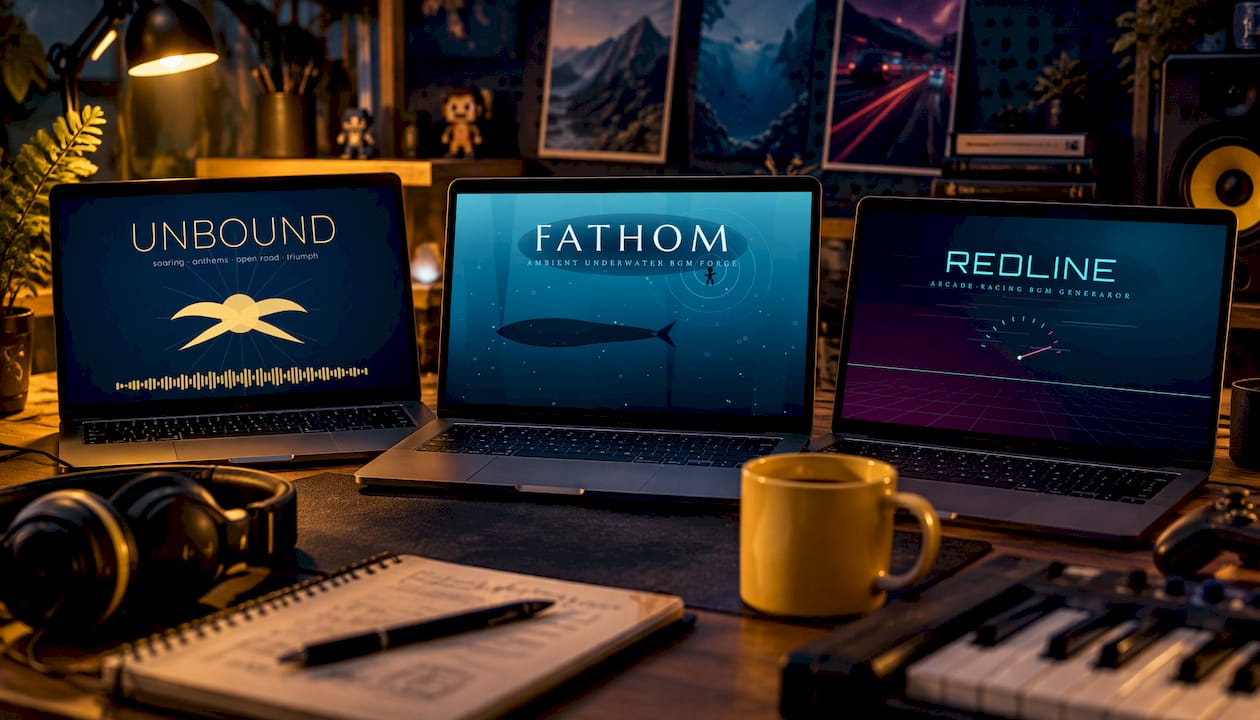
If your soundtrack is still empty, start with the Audio Generators and build one theme per area. Game-style generators such as UNBOUND, the absolute freedom BGM generator, are a quick way to hear what the browser tools produce. If you want music, art and tools together, the Lifetime Supporter Pass covers every RPG Maker plugin, tool, music generator and asset in the catalog, forever.
For sprites, tilesets and plugins to go with the music, browse Tilesets & Art and Plugins.
FAQ
Do I need a license to use a song in my indie game?
Yes, if the song is not your own or in the public domain. You need a sync license for the composition and a master use license for the recording. Both come from the rights owners, not from a store where you bought the track.
Is royalty-free music free to use in a commercial game?
Not automatically. Royalty-free usually means a one-time fee with no ongoing royalties, within the scope the license sets. Check commercial use, platforms, number of projects and attribution before you rely on it.
Can I use a short clip of a famous song?
No length makes a clip safe. A 2026 legal guide says there is no ten-second rule and that fair use rarely works for commercial games. Treat any identifiable use as needing a license.
What should a commercial game asset license allow?
At minimum, commercial use, modification and distribution inside your compiled game. Check whether credit is required and whether you may share the raw files, which marketplace licenses typically do not allow.
Does a free price mean a game is noncommercial?
No. A free download does not settle whether use is commercial, so a noncommercial-only license can still block a free game that carries ads or donations. Read the license text itself.
Sources
- How Songwriters, Composers, and Performers Get Paid (U.S. Copyright Office)
- Decoding Intellectual Property Law for Video Game Developers
- Getting Creative With Video Games: Sync Rights and Wrongs
- Music Licensing for Video Games: Rights, Costs & Risks
- Licensing Music for Video Games (Open Music Business)
- Legal Guide to Music Licensing Contracts (Game Developer)
- How Much Does It Cost to License a Song for a Game?
- Video Game Music Royalty Free? The Legal Answer
- What license types apply to game assets? (Kongregate)
- Creative Commons Attribution 3.0 United States legal code
- Creative Commons Attribution-NonCommercial-NoDerivs 3.0 United States legal code
- Game Asset Licenses Explained (Cinevva)
- Royalty-Free Game Assets: A Legal & Licensing Checklist
Recommended
- CADENCE — Military Academy BGM Generator
- Fallowland (Fallout4-like) BGM Generator – RPG Maker MZ & MV
- Subnautica-like BGM Generator – RPG Maker MZ
- SLAPSTICK — Wacky Cartoon BGM Generator
Disclaimer: This article is for informational purposes only. The author is not affiliated with the creators of RPG Maker or the plugins discussed. All plugin names, trademarks, and links belong to their respective owners. The author may include links to external projects or repositories. Readers should review each project’s license and documentation before downloading or using any plugin.